
The Association and a coalition of members are taking legal action against an onerous program.
On May 11, 2026, the American Bus Association, together with a coalition of motorcoach operators, filed a legal challenge in the U.S. District Court for the Southern District of New York.
This action addresses New York City’s motorcoach idling regulations and the Citizens Air Complaint Program, or CAC Program. As these policies are currently structured and enforced, they create serious challenges for safe, practical, and consistent motorcoach operations.
This was not a step ABA took lightly. We have spent significant time engaging with city, state, and federal stakeholders and working to find a constructive path forward. We remain committed to collaboration and to reasonable solutions. But after extensive efforts, it became clear that legal action is necessary to seek clarity, consistency, and alignment.
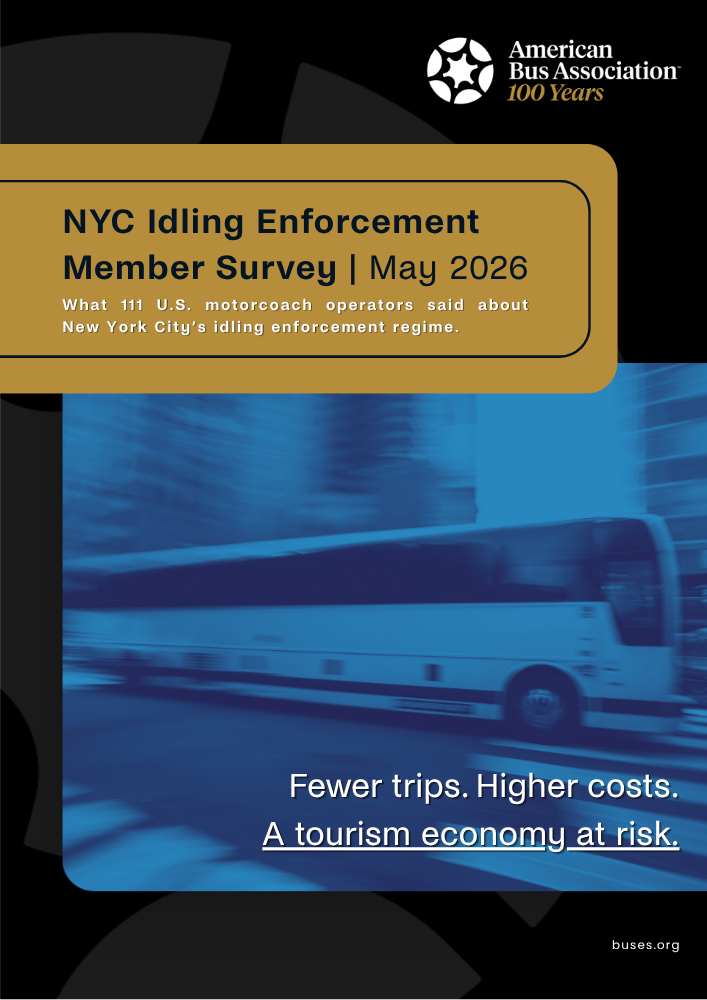
Our decision was also guided directly by member feedback. In ABA’s recent survey on this issue, 20% of ABA bus members responded, sending a clear signal that this is not just a local concern, but a national one for our industry. The overwhelming consensus from respondents was that New York City’s current approach is leading to higher costs and fewer trips. That feedback reinforced what many operators have been telling us directly: the current framework is creating real business consequences for companies across the country.
At its core, this case is about protecting safe operations and ensuring that motorcoach policy reflects the realities of how our industry works.
Motorcoach operators are required to meet strict federal safety standards. Those obligations include pre-trip inspections, maintaining safe operating conditions, and ensuring passenger well-being. At the same time, New York City’s idling rules impose limits that do not fully account for how motorcoaches operate in practice. That challenge is made worse by the fact that transit buses are exempt from the CAC Program, while private motorcoach operators are not. The result is an uneven enforcement environment that falls short of the basic principle of parity across transportation providers.
That creates real-world conflicts for operators. In some situations, members are being forced to navigate competing demands between local enforcement and federally grounded safety procedures, including the need to maintain appropriate cabin conditions and complete required operational checks. This is not theoretical. It is a daily operational challenge for companies serving New York City.
We are also deeply concerned by the structure of the CAC Program itself. The program allows private individuals to report alleged violations and receive a share of the resulting fines. That framework has contributed to a sharp increase in complaints and enforcement activity. At the same time, enforcement is not applied evenly across transportation providers, creating a system that is difficult to navigate and, in many cases, disproportionately affects private motorcoach operators.
“At its core, this case is about protecting safe operations and ensuring that motorcoach policy reflects the realities of how our industry works.”
Fred Ferguson, ABA
Our lawsuit seeks to address those issues directly.
Through this case, ABA and its members seek to ensure that local rules align with federal safety requirements, challenge enforcement structures that create unreasonable operational and compliance burdens, and support a more consistent and practical framework for motorcoach operations. More broadly, this action is intended to reinforce the role of motorcoaches as a safe, efficient, and essential part of the transportation system.
This matters not only in New York City, but across the country. As other jurisdictions consider similar policies, the outcome of this case could help shape how transportation regulations are approached nationwide. That is why this action is important for our members and for the industry as a whole.
ABA supports policies that advance environmental progress and strengthen the communities we serve. Motorcoaches already move large numbers of passengers efficiently, helping reduce congestion and emissions through shared transportation. We support progress. But progress must be grounded in operational feasibility, safety, and infrastructure readiness. Our goal is not to challenge environmental objectives. Our goal is to ensure that policy reflects current capabilities and real-world operating conditions.
We also believe members and stakeholders should have access to the full context of this action. The complaint and supporting materials is available for the public to read. The filing outlines the legal basis for the case, including concerns related to federal preemption, interstate commerce, and the practical realities of motorcoach operations.
We will continue to keep members informed as this process moves forward. In the meantime, we encourage members to direct media inquiries to ABA and to reach out with any questions or concerns.
A special thanks to our coalition of co-plaintiffs in this matter:
- Academy Express LLC
- Academy Lines LLC
- Panorama Tours Inc.
- Peter Pan Bus Lines
- Trans-Bridge Lines Inc.
- Adirondack Trailways of New York
- Hampton Jitney Inc.
- Leprechaun Lines Inc.
- Niagara Scenic Tours, Inc.
- Coach USA
- Greyhound Lines Inc.
And thank you, our members, for your continued partnership, engagement, and support as we work to protect all of your interests and the future of the motorcoach industry.
Sincerely,
Fred Ferguson
President & CEO