At a moment when cross-border tourism, tariffs, and political uncertainty are putting new pressure on the industry, Vince Accardi sees the partnership between the Ontario Motor Coach Association (OMCA), Motor Coach Canada (MCC), and the American Bus Association (ABA) as more important than ever.
As President of OMCA and MCC, Accardi is clear that this is not just about maintaining good relationships. It is about protecting business conditions for operators, strengthening advocacy on both sides of the border, and making sure bus and group travel continues to move people, revenue, and opportunity across North America. For ABA members, that partnership matters in practical ways: stronger alignment on policy, better business development opportunities, and a more unified voice when border access, tariffs, regulation, and tourism demand are all in play.
In this conversation, Accardi talks about what is driving his work right now and why the ABA-Canada relationship is valuable to members on both sides of the border.
What excites you most about your leadership roles?
“What excites me most about serving as president of these associations is the opportunity to lead from the front at a pivotal time for our industry,” Accardi says. “This moment demands bold leadership, cross-border collaboration, and a relentless focus on member value.”
That theme runs through everything he says. For Accardi, the motorcoach sector is not a side player in tourism. It is one of the systems that makes tourism work.
“Motor coach operators are the connective tissue of tourism,” he says. “Our members link communities, attractions, events, and the tourism economy across Canada and the United States. The Canadian-U.S. tourism market is deeply interdependent. Our success is shared.”
That is where the relationship with ABA comes into sharper focus. Accardi does not describe it as symbolic. He describes it as operational.
“Working closely with partners like the American Bus Association and the United Motorcoach Association strengthens that bond, demonstrates leadership, and ensures members on both sides of the border thrive.”
For ABA members, that message lands squarely on one of the Association’s central priorities: re-centering bus operators and making sure the industry’s value is understood in business, policy, and tourism terms.
What is your vision for the coming year?
“My vision for the coming year is simple but ambitious,” Accardi says. “To strengthen our associations’ value proposition and continue to grow membership, while reinforcing our members’ role and economic contributions to Canada’s and North America’s tourism sector.”
He quickly connects that vision to the current climate.
“Canada and the United States are one of each other’s largest international tourism markets,” he says. “A strong cross-border motor coach sector supports group travel, student tours, sporting events like the World Cup, and leisure markets that sustain thousands of businesses and support employment. Protecting and expanding that ecosystem is a top priority.”
His emphasis on tariffs is especially notable. He frames them not as a distant policy issue, but as a real business concern affecting fleet investment, operating costs, and long-term confidence.
“In practical terms, that means deepening collaboration with the American Bus Association and the United Motorcoach Association on advocacy and business development initiatives,” he says. “We are doing this in various ways, such as supporting ABA motorcoach and tourism economic research reports, working with ABA and UMA on the ongoing impacts of tariffs, and strengthening our own government relations here in Ottawa and at Queen’s Park.”
That kind of coordination is valuable to ABA members because it strengthens the case that cross-border tourism and motorcoach mobility deserve serious attention from policymakers. When both sides are aligned, operators are better positioned to push back on harmful friction and make the case for practical solutions.
What do people misunderstand about the work of OMCA and Motor Coach Canada?
“What many people don’t see is the depth of government advocacy and behind-the-scenes coordination that keeps our industry moving,” Accardi says. “When government border policies shift, regulations change, or transportation or tourism funding is debated, OMCA and MCC are at the table representing operators’ interests.”
That may be the clearest window into how he sees the current moment. Public attention often stops at the visible side of the business. The coach is on the road. The group arrives. The trip happens. What is less visible is the amount of work required to keep the business environment workable.
“The public sees the coach on the highway,” he says. “They don’t see the work required to have regulations that make sense for our members, the work we continue to do on tariffs, or to ensure cross-border mobility between Canada and the U.S. remains efficient.”
Again, he comes back to partnership.
“Our collaboration with the American Bus Association and the United Motorcoach Association is critical in aligning our voices on shared priorities across our borders.”
That alignment is important for ABA members because advocacy is stronger when it reflects a single, credible industry position. It also reinforces ABA’s broader role as a central forum for leadership, growth, and results across bus and group travel.
Accardi also points to the business-building side of the work.
“It can be difficult to communicate the efforts that go into building business opportunities for our members,” he says. “Motorcoachcharters.ca is a perfect example of an initiative that drives public awareness on chartering a motor coach and the importance of using a licensed tour operator, while at the same time driving charter requests directly to our members.”
For him, advocacy and commerce are not separate tracks. Both are part of member value.
“Constructive partnership means early engagement, sharing insights, data, and policy concerns before they become challenges. It also means aligning advocacy efforts with organizations…so that governments hear consistent, solutions-oriented messages.”
Vince Accardi, OMCA & MCC
How should ABA and other associations work with you?
“Effective collaboration begins with open communication and shared objectives,” Accardi says. “Associations are strongest when we approach issues with a unified voice, particularly on cross-border tourism and regulatory matters.”
He is especially direct about what that looks like in practice.
“Constructive partnership means early engagement, sharing insights, data, and policy concerns before they become challenges,” he says. “It also means aligning advocacy efforts with organizations like the American Bus Association and the United Motorcoach Association so that governments hear consistent, solutions-oriented messages.”
That is a useful framework for ABA members. It suggests that the value of this relationship is not only in joint statements or good intentions. It is in coordinated problem-solving before challenges harden into policy or market damage.
Accardi also makes the broader economic case.
“Our markets are intertwined,” he says. “Canada’s tourism success depends on American visitors, and U.S. operators benefit from strong Canadian destinations and partners. When associations work together to grow demand and reduce barriers, everyone wins.”
That may be the most important line in the interview for ABA members. It is a reminder that the Canada relationship is not peripheral. It is directly connected to trip demand, destination access, supplier relationships, and industry growth.
What struck you most when you first stepped into this role?
“My first day was a mix of excitement and responsibility,” Accardi says. “Walking into an association with nearly a century of history carries weight.”
But what stayed with him most was the resilience of members.
“I joined in April of 2021, and our industry and members, like the rest of the world, were in turmoil,” he says. “I’m still so impressed with our members who have weathered economic cycles, regulatory shifts, and global disruptions, yet remain deeply committed to serving group travel across Canada and the United States.”
That experience appears to have sharpened his view of the ABA relationship.
“I was also struck by how interconnected our work is with partners like the American Bus Association and the United Motorcoach Association,” he says. “It became clear that cross-border relationships were not optional. They are foundational.”
That is the clearest takeaway from this conversation. In the current political climate, with tariffs and cross-border tourism in the crosshairs, the OMCA-MCC-ABA relationship is not just about association goodwill. It is a business asset for members. It helps protect operator interests, strengthen advocacy, support growth, and keep the industry focused on practical outcomes when uncertainty is high.
Or, as Accardi puts it, “Our mandate was to lead the group travel industry from the front, to strengthen government relations, and to rebuild and grow membership.”
For ABA members, that kind of partnership is not abstract. It is part of how the industry moves forward.
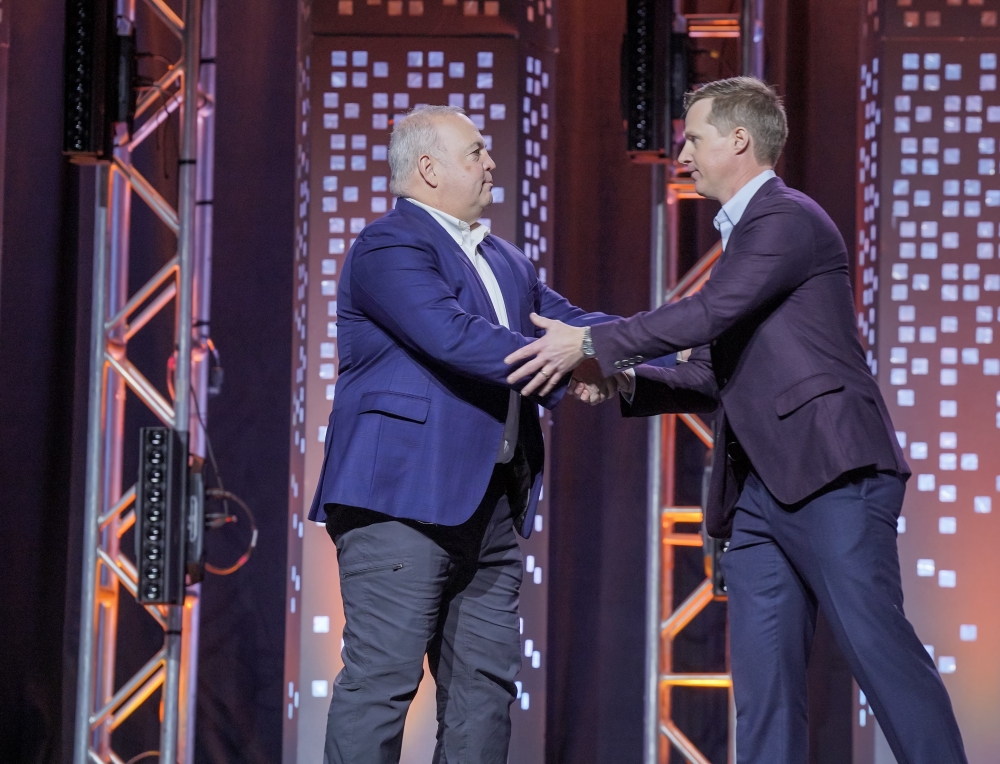
Photo top: Vince Accardi (left) and Fred Ferguson on stage at Marketplace 2025 in Philadelphia, PA.