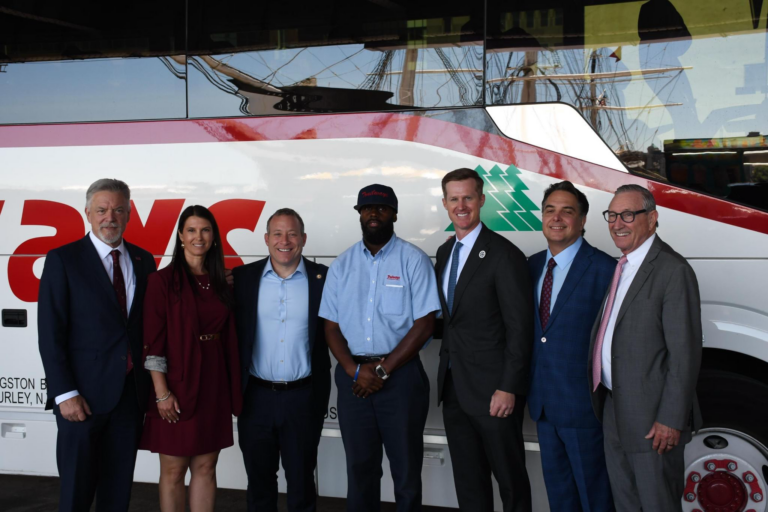
The bipartisan legislation would deliver clearer rules, stronger protections, and real operational relief for bus operators.
The American Bus Association is helping lead one of the bus industry’s most important federal advocacy efforts this year with the bipartisan Buses Utilizing Safety and Environmental Standards (BUSES) Act, announced June 16 by Reps. Josh Gottheimer and Nick Langworthy. The legislation would establish a 15-minute federal floor for over-the-road bus idling rules, end bounty-style enforcement tied to bus idling violations, and prevent citizen suits from being used against operators for basic operational needs. For ABA and its members, the bill represents a practical, safety-focused response to a growing problem that has hit interstate bus service especially hard in New York City.
ABA’s contribution to this effort has been substantial. President and CEO Fred Ferguson joined the New York announcement alongside operators, drivers, and allied business leaders, and he testified before the House Energy and Commerce Subcommittee on Environment on June 3 to urge Congress to advance the legislation. ABA has consistently framed the issue around a balanced standard: one that preserves clean-air goals while recognizing the real-world operating conditions bus companies face every day. The association has emphasized that the BUSES Act would not eliminate anti-idling laws or authorize unlimited engine operation. Instead, it would create a narrow federal standard that distinguishes unnecessary idling from short periods of engine use needed for safety, accessibility, and passenger comfort.
“Professional bus operators deserve clear, consistent rules that allow them to focus on safety. The BUSES Act provides the certainty our industry needs while protecting the passengers who depend on motorcoach transportation every day,” said Ferguson. “Motorcoaches are already one of the most environmentally responsible group transportation options available. They deliver the lowest carbon emissions per passenger mile while helping relieve congestion by moving more people in fewer vehicles. As policymakers look for safe, efficient ways to expand mobility, buses belong at the center of the solution.
“We thank Congressman Josh Gottheimer and Congressman Nick Langworthy for their bipartisan leadership on this legislation and for recognizing that safety, mobility, and common-sense national standards can go hand in hand. The BUSES Act gives operators the clarity they need to keep passengers safe, comfortable, and moving.”
Professional bus operators deserve clear, consistent rules that allow them to focus on safety. The BUSES Act provides the certainty our industry needs while protecting the passengers who depend on motorcoach transportation every day
Fred Ferguson, ABA
That advocacy is grounded in the direct experience of ABA member organizations. According to the Gottheimer release, New York City’s current enforcement regime does not clearly distinguish between a vehicle sitting idle without purpose and a motorcoach actively serving passengers. In practice, operators have been penalized while conducting federally required safety inspections, loading elderly passengers and passengers with disabilities, operating wheelchair lifts, or maintaining safe cabin temperatures during extreme heat. Since 2020, more than 4,000 summonses have been issued against private bus carriers in New York City. ABA survey data cited in the release found that 35 percent of affected operators have reduced trips into the city, 20 percent have turned down charters, and 10 percent have stopped operating there altogether.
ABA has reinforced that message through legal action as well. In May, the association, joined by interstate motorcoach operators, filed a federal lawsuit challenging New York City’s enforcement program. ABA argued that the current system unfairly targets private carriers, burdens interstate commerce, conflicts with federal safety requirements, and threatens an industry that generates more than $12.7 billion in economic impact and supports 59,200 jobs in New York alone. That broader strategy, pairing litigation with congressional advocacy, has helped move the issue from an operator complaint to a national policy discussion.
For ABA member organizations, the benefits of the BUSES Act would be immediate and meaningful. A consistent federal standard would reduce uncertainty for operators that cross state and local jurisdictions, lower exposure to punitive and inconsistent enforcement, and protect the ability to serve passengers safely and accessibly. It would also help members preserve service to high-demand markets, avoid unnecessary costs, and continue providing one of the most efficient forms of group transportation available. More broadly, the bill shows ABA at its best: using research, member testimony, legal action, and direct advocacy to defend operators and advance practical policy solutions that keep buses moving.