For many organizations looking at the approaching end to their fiscal year, a familiar question arises: how do we use remaining budget dollars wisely without simply spending for its own sake?
For companies considering a July 1, September 30, or other fiscal year turn, ABA Marketplace offers a strong solution: invest now to reap future dividends. The best strategy is not to think about Marketplace as a single expense. Think about it as a multi-layered business investment that can help you close out one budget year with purpose while setting up the next one for stronger returns.
That matters because Marketplace is not just another industry event. According to ABA’s 2026 Business Impact Report, Marketplace generated an estimated $124.9 million in total sales-based transaction activity, including $49.0 million in business booked directly at the show and $75.9 million in anticipated future business tied to Marketplace appointments and connections. The report also found that 47% of firms reported booked business at Marketplace, while 82% reported future business resulting from participation.
That combination is exactly why Marketplace fits so well into a fiscal year transition strategy.
Use This Year’s Budget to Drive New Opportunities
If your organization still has budget available in the current fiscal year, Marketplace is one of the clearest ways to convert those dollars into visible, measurable business development.
Using current-year funds to register early, secure booth space, or add sponsorship visibility can do more than help you use up your budget responsibly. It can improve your position before the event begins. It can help you take advantage of early pricing, provide access to more hotel and travel options, and give your team more time to plan meetings, outreach, and onsite strategy.
In other words, you are not just buying attendance. You are buying preparation time, visibility, and the ability to show up with a more intentional plan.
That matters in a Marketplace environment built around scheduled one-on-one appointments and structured business development. The Business Impact Report describes Marketplace as a platform where relationships formed during the event often translate into tour itineraries, destination partnerships, supplier agreements, and continuing economic activity long after the show ends.
Use Next Year’s Budget to Expand the Return
The second half of the strategy is just as important.
Once registration, booth space, and/or sponsorship is covered with current-year dollars, next year’s budget can be used to amplify the return on that initial investment. That may mean bringing a fuller team, increasing client entertainment, expanding pre-show outreach, investing in better activation, or building a more deliberate appointment strategy around your business goals.
This is where Marketplace becomes especially valuable during a fiscal year turn. Instead of asking for one budget year to carry the full load, companies can spread the investment across two cycles and get more out of both.
One budget year secures your place. The next budget year helps you maximize the outcome.
That is a more strategic approach than waiting, compressing decision-making, and forcing all Marketplace costs into a single accounting period.

The Data Supports the Case for Earlier Commitment
The Marketplace return story is not hypothetical. It is already showing up in independent data.
The 2026 Business Impact Report found that Marketplace participation delivered measurable commercial value across all major entity types, not just one segment of the industry. The report notes that business generation is broad-based, not concentrated in a single category, and that Marketplace functions both as a venue for immediate transactions and as a catalyst for ongoing business development.
That is an important point for budget planning. Marketplace return is not limited to what is booked on-site. In fact, the report found that anticipated future sales exceeded confirmed booked sales, underscoring the event’s role as a relationship-building and pipeline-development platform.
For finance teams and decision-makers, Marketplace is easier to justify as a strategic investment rather than a travel line item.
Why the Fiscal Year Window Matters
A fiscal year turn creates a rare moment when organizations can be more deliberate than usual.
Teams with remaining budget can act now rather than wait. They can use this year’s dollars for foundational commitments such as registration, sponsorships, and booth space. Then, once the new fiscal year opens, they can use a fresh budget to support activities that increase ROI: staffing, appointments, promotions, customer engagement, and follow-through.
This approach gives companies several advantages:
First, it increases the total value from the existing budget.
Rather than letting funds expire or rushing them into lower-impact spending, companies can direct them toward a business platform with demonstrated returns.
Second, it reduces pressure on the next fiscal year.
When core Marketplace costs are addressed early, next year’s budget can be used more strategically.
Third, it improves execution.
The earlier a company commits, the more time it has to build a better onsite and post-show plan.
Fourth, it aligns spending with how Marketplace actually creates value.
Some of the returns are immediate. Much of it develops through meetings, pipeline building, and follow-up over time. The report’s split between booked business and future business reflects exactly that dynamic.
Marketplace Is Built for Measurable Return
The credibility of the Marketplace ROI story also matters. This was not anecdotal feedback alone. The Business Impact Report was conducted by Tourism Economics and was based on post-event survey data from 328 firms, representing a 25% response rate among the 1,308 unique firms that attended Marketplace. Results were then extended across the attendee base using a defined methodology.
The report also found strong attendee confidence in the event: 88% of firms said Marketplace met or exceeded expectations for generating business, and the overall likelihood to return was 8.8 out of 10.
That kind of response gives budget owners and senior leaders what they need: evidence that Marketplace performs not only as an event but also as a commercial platform.
The Bottom Line
If your organization is approaching a fiscal year turn, the question is not whether Marketplace is worth considering. The better question is how to use your budget timing to get even more out of it.
Use remaining current-year funds to secure your position now. Then use next year’s budget to expand your presence, sharpen your strategy, and drive a stronger return.
That is how you turn a fiscal year deadline into a business advantage.
And that is how Marketplace becomes more than a registration decision. It becomes a smarter way to finish one budget year strong and start the next one with momentum.
Don’t let unused budget go to waste. Register now for Marketplace before your fiscal year ends and start building your 2027 pipeline.
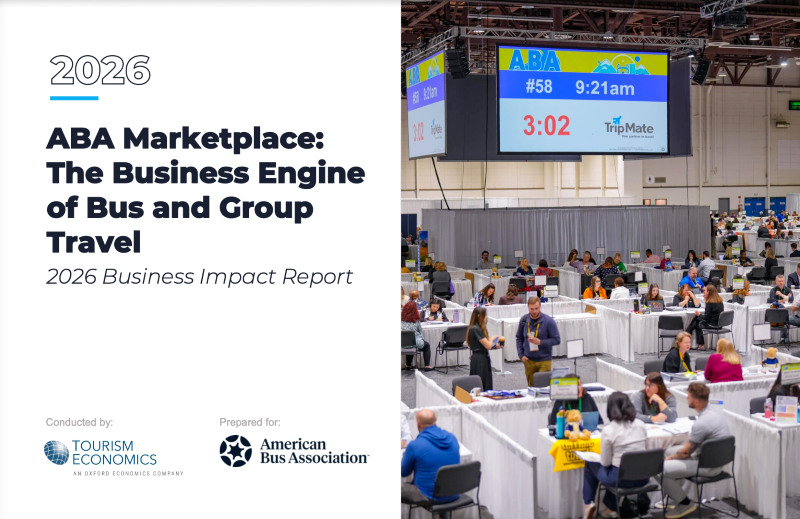
2026 ABA Marketplace Business Impact Report
The 2026 ABA Marketplace: The Business Engine of Bus and Group Travel Business Impact Report evaluates the volume of business transacted at the event and the pipeline of future activity resulting from Marketplace participation. The report quantifies business booked directly at Marketplace, anticipated future business resulting from Marketplace, and total transaction volume generated across participating firms.